


Dr. Milwida M. Guevara
Synergeia Foundation1
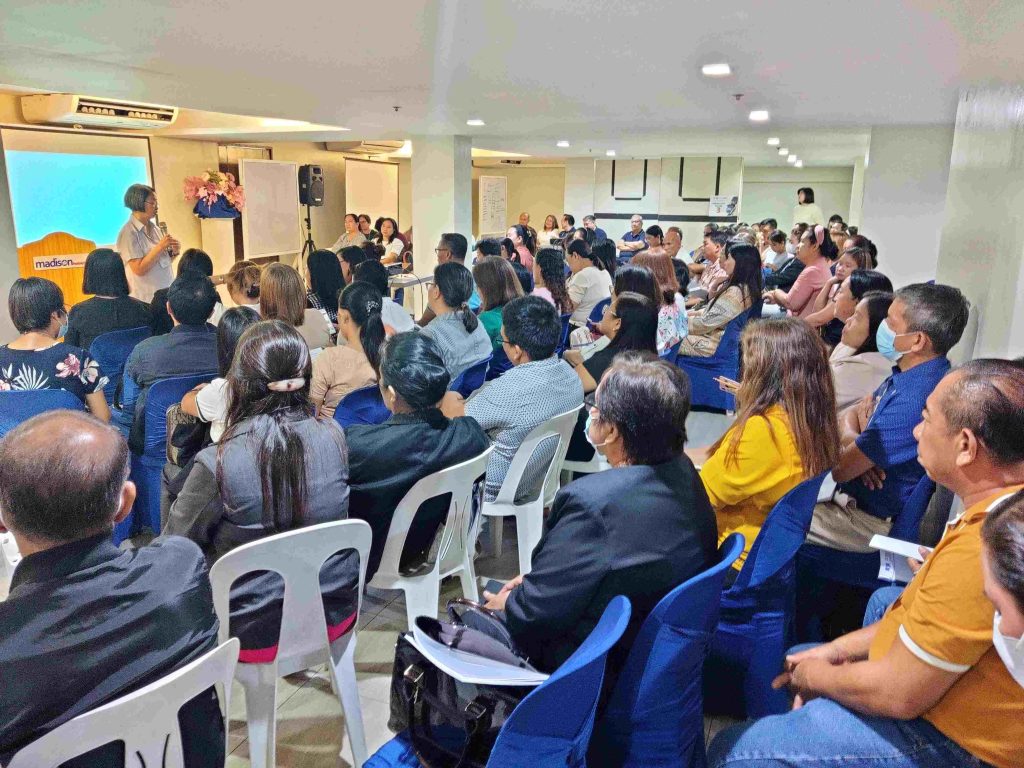
It was like coming to a family reunion. The participants looked genuinely happy to be there. It was so unlike earlier meetings when they literally dragged their feet to attend the POC meeting. Visiting the Provincial Capitol can be quite a hassle, especially for those who have traveled three to four hours by public transportation.
Gone were their faces of indifference. They were excited to hear the results of the pre-assessment test in Reading. And how their faces lit up when they learned about the experimental group’s performance. On average, the experimental group scored 74% compared to 69% for the control group. The difference between the mean scores of the two groups was statistically significant at the 1% level.
What joy to realize that their interventions translated into better learning outcomes! They proved that training workshops can be more effective and responsive to local needs when designed and delivered by teacher-leaders. They could train their peers with greater passion and skills. Not even the best consultants with PhDs can beat experience, empathy, and context.
We are finally seeing how Local Chief Executives become education mayors. They now experience how education enables them to become better leaders and more popular. They learn that listening is as important as making speeches. They focus on students’ performance outcomes rather than relying on stories and anecdotes. They develop systems instead of projects. In so doing, they are not just focused on building schools but also on feeding programs and training parents and teachers, as children’s needs are diverse.
1. How It All Started.
Ciel Habito, Ernie Garilao, Mike Luz, Gilbert Llanto, and I, committee members of EdCom 2’s Committee on Decentralization and Finance, are kindred spirits in many ways. We all experienced working with Former President FVR and went through the gains and pains of devolution. We share similar insights and lessons on how empowering local governments and their communities can enhance the delivery of basic education. But we did not jump to a conclusion hastily. What do studies say? Each of us was assigned to review the literature and met several times to discuss country experiences, results, challenges, and how they were addressed. Fred Ayala and Vince Fabella enriched our discussions through additional workshops organized by EdCom 2.
We were very clear on the differences between decentralization and devolution.
- Decentralization transfers decision-making authority closer to the consumer or beneficiary.
- Devolution is transferring or delegating power to a lower level to local or regional administration.
Most studies in the Philippines discuss the decentralization of basic education, but not its devolution to local governments.
2. The Indonesian Model
After reviewing several countries’ experiences, we believe the Indonesian experience offered the best model for the Philippines. The Indonesian model is based on the following precepts to develop “emancipated learners.”
- Embracing diversity. Curriculum is not a set menu. Schools can focus on what children need and which parts of the curriculum meet their needs. Schools were authorized to conduct their teaching practices and were encouraged to engage with local communities to enhance the quality of education.
- The principal is the unit of change, and his/her role is transformed from being an administrator to a chief mentor and chief coach
- Peer-to-peer training of teachers is emphasized.
The functions of the different levels of government have been clearly defined. The central government:
- sets policies, the national curriculum, and a national examination and assessment system.
- Sets standards for (i) achievement at each age; (ii) learning materials; (iii) acceptance, transfer, and certification of students; and (iv) learning times for basic education and educational calendar.
- Defines procedures and standards for staff appointments and dismissals, pensions, salaries, benefits, and rights and obligations
- Establishes the legal status of civil servants and regional civil servants, including teachers and principals.
The District government is responsible for planning, financing, managing, and delivering basic education. It also has the power to manage school staff appointments and transfers and plan school locations.
The Provincial Government:
- defines policy on student selection and acceptance
- provides instructional materials for basic education
- assists in higher education management, curriculum production, accreditation, staff appointments, and opening and closing of colleges
- manages special institutions, including training centers, teacher training institutions, and special education
- handles transfers between districts, cities, and provinces of civil servants, including school principals and teachers.
Sufficient evidence has been established that the Indonesian experience improved average educational outcomes in selected districts participating in the program. Enrollment, completion rates, and achievement rates increased. More importantly, the experience resulted in: 1) Greater equity in terms of access, completion, and achievement of poorer students; 2) greater capacity of schools in determining priority education challenges and identifying corresponding strategies to address them; and 3) induced communities to participate actively in school development through the formation of school committees.
3. The Philippine Model
Will the devolution of basic education work in the Philippines? Will it improve the quality of basic education? Will teachers’ and children’s performance improve? Will they be happier if they are given more freedom? Many questions needed answers, and numerous assumptions needed testing. Our Sub-Committee decided to conduct a Proof of Concept to test whether devolving the delivery of basic education to local governments would yield positive results. Part of our thought process involves determining which services can be devolved and identifying who can perform them most effectively. We agreed that the basic unit of devolution could be the provincial government. The province is better positioned to lead municipal governments and component cities in developing a shared vision for children and an education development plan. Moreover, the province disburses 50% of the Special Education Fund tax collected by municipal governments. The province can provide leadership in ensuring the SEF fund is disbursed equitably and efficiently so that no child in the province is left behind.
4. Selecting Iloilo. Iloilo province was an ideal choice for the POC. The current Governor, Mayor Toto Defensor, recently proclaimed that even if education were not a devolved function, local governments must embrace it as their primary responsibility. Another factor that worked in Iloilo’s favor is its Provincial Administrator, Raul Banias. He successfully led the education reform while serving as Mayor of Concepcion, Iloilo, an island municipality in the province of Iloilo. Mayor Banias is not only a passionate reform advocate, but he also successfully increased enrollment, completion, and achievement rates during his term. Quality education was the core of his zero-poverty program.
We had no difficulty convincing them to undertake the POC, and they readily accepted the challenge. PA Raul set the process in motion by consulting with Mayors who were willing and able to participate in the experiment. Ten Mayors joined the experimental group, and another ten were selected as the control group. We ensured that the control and experimental LGUs had similar characteristics, including income classifications. However, the POC would be more complete if the bustling city of Iloilo could participate as a member. We capitalized on our friendship and harmonious working relationship with Mayor Jerry Trenas. We remember Mayor Jerry, who nearly had a diabetic attack years ago upon learning that the Iloilo children scored only 45% on the National Achievement Test. Fortunately, his passion for education remains unchanged and has even become more fervent. Since we were already leveraging Synergeia’s social capital, we increased our efforts by requesting that the Coca-Cola Foundation, through its President, Cecille Alcantara, support the inclusion of Pavia in the POC. Coca-Cola has a plant in Pavia and views children’s education as significant to its Corporate Social Responsibility (CSR). Our POC is now at work in 12 local government units.
Table 1. Coverage of the Proof of Concept on the Devolution of Basic Education, Iloilo Province and Iloilo City
| Experimental Group | Control Group |
| Cabatuan | Sta Barbara |
| Barotac Viejo | Badiangan |
| Guimbal | Bingawan |
| Mina | Anilao |
| Pavia | Barotac Nuevo |
| Sara | San Enrique |
| Igbaras | New Lucena |
| Maasin | San Rafael |
| Leganes | Concepcion |
| Batad | Ajuy |
| Iloilo City | Lemery |
A crucial step is finding some seed money for the POC. Senator Sonny Angara’s COS, Atty. Fatima Panontongan came to the rescue and asked us to draft a proposal for the senator’s consideration. Senator Angara approved the integration of P5.08 million into DILG Region VI’s budget and steered it through the GAA approval.
5. Getting Everybody on Board
Governor Defensor invited all 11 mayors to a workshop on January 12, 2024. PA Banias played a pivotal role by cajoling, influencing, and gently pressuring all of them to come. Since the funding for the program has been lodged with the DILG, the DILG Regional Director and his staff were present to discuss how they can support the POC. They were shocked to learn that only 3 out of 10 students in the province (27.80%) were grade-ready. I seized the moment and asked the mayors about the percentage of students who were non-readers. Most were embarrassed that they couldn’t give the correct answer, prompting them to commit to doing better.
What better indicator than their enthusiastic participation in target setting? The targets they set were even higher than those proposed by a DepEd official. Instead of accepting her target of improving reading competency in Hiligaynon, the Mayors raised the bar by setting proficiency in English as their target. Their vision was that at least 75% of grade 3 child should be able to read a simple story and answer questions that test their comprehension. Governor Defensor upped the ante by increasing the target to 100%. To achieve this goal, their objectives included strengthening their Local Support Bodies (LSBs) and mobilizing community participation. They agreed to accept the following responsibilities, which the central government currently performs:
- Training of principals and teachers.
- Development, procurement, and delivery of reading materials.
- Pre-and post-assessment of performance by children and teachers.
- Training parents and guardians.
- Regular assessment of learning performance
Most importantly, they embraced the accountability that comes with the POC’s success and failure.
It did help that the Department of Local Governments and Interior supported the Reinvention of Local School Boards.
6. The Rocky Road Towards Devolution.
As the saying goes, devolution is easier said than done. Studies have documented the challenges posed by devolution. The POC in Iloilo enabled us to meet those challenges face-to-face. We addressed those we could and identified those that will require policy and behavioral changes, as well as a more concerted effort from all agencies and levels of government.
6.1. A Strong and Efficient Education Team in the Office of the Local Chief Executive Government
Because education is not a devolved function. Local Chief Executives operate under strong central government control. In most cases, DepEd policies are rigid, leaving personnel with little room for discretion. However, a determined and visionary leader can guide this “memocracy “system toward greater autonomy.
The Provincial Governor of Iloilo can be such a change leader. Governor Defensor believes that education is a core function of local governments. He can lead the province in formulating a shared vision for education and in developing a roadmap to achieve it. Since 50% of the Special Education Fund (SEF) is shared with the province, the Governor can steer an efficient and equitable allocation of the SEF budget.
An ace in the governor’s sleeve is an able administrator who can translate the Governor’s vision into processes and activities. He can also direct and coordinate program implementation. The current administrator, PA Raul Banias, does this very well despite a heavy workload. To lighten his load, he organized an EDCORE team to plan and implement the POC activities.
The EDCORE, however, is composed of personnel borrowed from various departments of the Provincial Government. They are preoccupied with assignments from their principal offices and are not fully dedicated to planning and coordinating the change process. Although they possess passion and commitment, they are part-time change agents who are supposed to multitask.
Their interim assignments deprived them and us of opportunities to collaborate on planning and capacity building. We are unaware of their strengths and weaknesses. It would also be to our mutual benefit if they joined us in workshops with teachers, parents, and principals and monitored student performance. We could have shared what we learned about doing these processes well.
Municipal governments have a similar limitation. No office oversees the Local Chief Executive’s education programs. The Mayor is assisted by an individual, such as the Planning Officer or the Councilor, who serves as the Chairman of the Education Committee. He/she asks for the help of the District Supervisor and Principals. To our great delight, the Municipal Teams came to the task despite the myriad of their activities. A priori, the X factor can be the full-time participation of the municipal staff members in all our training programs. They may have acquired the attitude and skills essential to initiate the change process, such as thorough and participatory planning, active listening, conducting interactive workshops, providing creative activities, mentoring, and coaching.
We look forward to an ideal scenario where the local Education staff can plan, drive, and coordinate activities to improve learning performance. However, we are aware that this capability must be progressively developed. Capacity-building workshops must be supplemented with mentoring and handholding. Our Program Officer, Edwin Nacionales, does this in many ways, and devolution needs more than one Edwin.
6.2. Capacitating the Local Bureaucracy
Local governments have their own bureaucracy. Their accounting and procurement offices are used to adhering strictly to central government rules. Rather than thinking outside the box, the local bureaucracy searched for regulations to follow—but since this was a proof-of-concept (POC), there were none. They were uncertain how funds transferred from the DILG could be properly utilized.
Our efforts were heavily focused on building teachers’ and principals’ capacity, but we underestimated the importance of engaging other key stakeholders. Coming in from the cold, the local bureaucracy did not understand the devolution of basic education and what was expected from them. As a result, the provincial government had to shoulder the cost of the initial workshops, and a significant portion of the devolved funds remained underutilized.
6.3. Changing Mindsets
DepEd is like any organization. There are progressive leaders and those who are “DepEd na DepEd.” They follow a chain of command and are part of a hierarchical culture that separates leadership from the staff.
Rigidities at the POC took several forms: strict adherence to minimum competencies, reluctance to try non-traditional practices, review and approval by multiple offices, conflicts with internal schedules and personalities. There were times when DepEd activities, intentionally or unintentionally, overlapped with POC workshops, preventing many principals and teachers from participating. A school official was bothered that we took some students to the museum. He pontificated that “learning only happens in the classroom.”
We attempted to organize collaborative planning but were unsuccessful due to the absence of the local “Samurais”. We operated with a different power base: the leadership, power, resources, and influence of the Local Chief Executives. We also found some DepEd officials who were open to change and collaboration.
The hierarchical system was extended to some principals and teacher-leaders. They gave long lectures and dominated the discussions. It was painful and difficult to witness how a teacher took all the speaking roles in an activity while the rest were assigned passive roles.
We need to be conscious of how principals can disempower local shareholders. They may have become so accustomed to giving directions and assuming leadership that they can hinder parents’ initiatives. The POC had to redo the parents’ planning because their plans were limited to supporting the principals’ programs. With greater freedom, we discovered that parents can design how they can become “Nanay and Tatay—Teachers.”
6.4. Reinventing the Provincial School Board
The Provincial School Board is not set up to coordinate the education programs of its municipalities. Its members are provincial government officials with no participation from municipal governments. This despite the allocation of one-half of the Special Education Fund (SEF) collection to the province.
An interim arrangement was made in the POC, with the regular meeting of mayors and the governor. The first meeting was to agree on the objectives, processes, and targets. The second meeting, on July 12, 2004, was to sort out the birthing pain and define roles in implementing the work program.
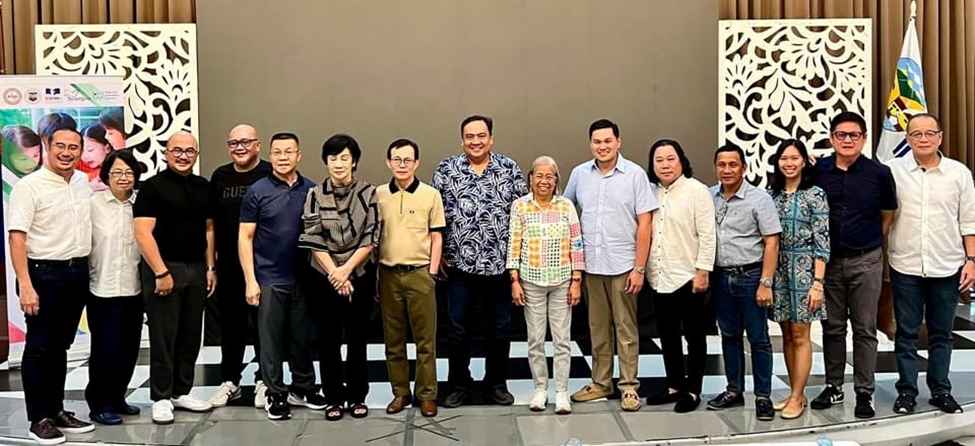
The Iloilo Mayors, Provincial and DILG Officials collaboratively planned the road map for the POC.
| Timeline | Output | Responsibilities |
| July to August, 2024 | Rollout of teachers’ training | Mayors 1) Convene LSB, principals, and teacher leaders to plan and support roll-out through school mentoring, group workshop 2. See to it that the roll-out is implemented 3. Designate focal persons for the POC 4) Augment the GAA support Provincial Government– Monitor the progress of implementation. Provincial Government and DILG Design incentive schemes to reward performing LSBs (if possible, schools) Synergeia-suggest process for rolling out teachers’ training |
| August, 2024 | Conduct a pre-assessment of reading skills | Mayors and LSB– plan and coordinate the administration of pre-assessment (distribution of assessment tools in the different schools, submission of the data to the Provincial Education Core Team Provincial Government– Coordinate the distribution of assessment tools to the LGUs and the retrieval of the records of test scores. Synergeia and PIDS designed the assessment tools and the analysis methods. |
| August 2024 | Distribution of the Children’s Workbooks | Synergeia-Development of workbooks and lesson plans Provincial Government– Reproduction of the workbooks and manuals and distribution of the learning materials to the different LGUs. Augment the GAA budget for learning materials. Mayors and LSB Coordinate the distribution of workbooks. Augment the budget for learning materials |
| September | Conduct of Municipal Education Summit | Mayors and LSBs -Organize the summit to inform the community on the reading performance of children and inform members on the POC -Encourage parents to help improve the reading performance of children and suggest programs that they can undertake through the School Governing Councils – |
| Training of Parent Leaders | Synergeia -Design and Conduct the Parent Leaders’ Training Provincial Government Organize the Training Mayors and LSB Support the participation of parents, e.g. provision of transport | |
| August 2024- March 2025 | Conduct of Reading classes and support of parents on the reading program | Mayors and LSBs, Monitor the POC’s progress through their monthly LSB meetings. Address the difficulties of teachers Synergeia and Provincial Government Design tools for monitoring progress and analyze data |
| End of March 2025 | Post-assessment of reading performance | Synergeia and PIDS Design assessment tools and process Analyze results Provincial Government Coordinate the administration of the test by the LGUs Mayors and LSB Coordinate the administration of the test to the different schools DILG and Provincial Government Administer the Incentives based on performance |
6.5. Principals Know Best
Devolution can lead to training programs that are more responsive to stakeholders’ needs. Training can be contextualized to reflect local priorities rather than a top-down approach or stereotypical programs. This empowers local stakeholders to assess their training needs and co-design relevant programs.
We invited principals to a workshop to develop a training program based on their perceptions of their roles, strengths, and weaknesses (February 21, 2024). They were quite conversant in being coaches, mentors, motivators, and inspirers. They said they are managers who make the school a “happy organization.” But they were candid in saying that some principals fall short in fulfilling these roles.
Principals lack a clear vision for the school and fail to set targets or success indicators for learning performance. They are not mentors, do not inspire and motivate teachers, do not facilitate peer learning, or give teachers a chance to shine and exercise their creativity.
They lack community relations. Most importantly, they lack the moral authority to lead—they do not lead by example, as they do not walk the talk. Specifically, they enforce rules they do not follow and fail to practice transparency in MOOE budgeting and utilization. Some are habitually tardy, frequently absent, and “mediocre.”
The ‘bad’ principals are overly strict, inconsistent, tactless, unapproachable, talkative, impatient, heartless, unfriendly, and inconsiderate.”
In fairness, the participants gave reasons for these lapses. Their heavy workload on administrative matters gives them little time for research. Another reason is a weakness in instructional leadership that hinders their ability to observe classes and discuss how to improve pedagogy and classroom management. However, they found it difficult to explain the lack of integrity.
They suggested a capability program focused on data organization and analysis, mentoring, and reading. The principals designed their menu.
For two days, principals worked on exercises to organize test scores, summarize findings in a few sentences, and use the data to design a remedial reading program. They worked on case studies that required them to actively listen and form a consensus. Mentoring was introduced through poetry. Studies on the effective use of phonics were reviewed. We ended with more than a call to action- every principal drew a work program so that children could read better.
6.7. Teachers Know What is Best for Them, Too.
It is common for teachers to complain about the myriad of their administrative work, inadequate learning materials, and uncooperative parents. But what stood out during this training was hearing their frustration with being “confined to a curriculum that restricts them from thinking outside the box.” If only we were free to be creative, we would do our best for the children of Iloilo.”
Creativity, however, is just the starting point. Teachers recognized the need to be grounded in theories and best practices on how children learn to read. They emphasized the importance of making learning concrete, suggesting that demonstration and practice teaching are among the most effective methods. They also asked for sessions focused on how to frame questions that promote critical thinking.
Eager to grow, the teachers expressed a strong desire to develop their communication skills, both oral and written. They acknowledged, however, that this skill requires consistent practice rather than a one-time training session. They identified the Learning Action Cells (LAC) as a valuable platform for ongoing learning and improvement.
The teachers were served a training program based on what they ordered. The four training days, May 8 to 11, 2025, were fun learning days.
We discussed intensively how reading can be taught using Systematic Phonics Instruction. The process involves:
- Phonemic awareness: production of the correct sound for every letter in the English and Filipino alphabet. Fortunately, many letters in these two alphabets have similar sounds.
- Developing fluency by enabling students to identify, isolate, categorize, add, delete, and substitute sounds
- Blending sounds to form syllables and words
- Comprehending words, phrases, and sentences
- Thinking and Creativity-making inferences, analysis, generalizations, and application
The program was experiential and interactive. Synergeia mentors demonstrated that reading can be taught rather than delivered as lectures. We used games, poems, songs, and role-playing.
They rediscovered the power of storytelling in building comprehension and critical thinking skills. They also reflected on the richness of local stories and history, recognizing their potential to make lessons more meaningful and relevant. We also had sessions on how to ask questions beyond the “who, what, where, and how.”
Workshops were organized to enable teachers to demonstrate their best practices and learn from one another. They explored both the science and art of reading, asking critical questions like: How do children learn to read?
The teachers described their experience as “different, innovative, interesting, creative, and useful.” They felt pretty special being housed in a hotel. What a treat to spend evenings dancing, singing, and playing games with their peers. But the best treat of all was a visit and a picture-taking session with Governor Defensor and Mayor Trenas.
.The training pushed their creativity as they worked together to develop a roadmap for improving their students’ reading skills. The path ahead may be challenging, but they left inspired with a symbolic gift: a bottle of healing oil, a reminder of care, resilience, and hope.
6.8. The leadership of Local Chief Executives
Our first real test of whether devolution could work came with the rollout of teachers’ training, and the results exceeded our expectations. Local governments, teachers, and their principals embraced the challenge with enthusiasm and commitment. The Mayors took the lead, forming Technical Working Groups (TWGs), convening educators, and listening to their suggestions on how Grade 3 teachers could become more effective reading instructors.
Their leadership was not just symbolic—it was hands-on and deeply involved. The Mayor of Pavia went further, mandating participation from all teachers in Grades 1 to 6. The Mayors of Mina and Cabatuan believed the training should include Grade 1 teachers and reading facilitators. In Barotac Viejo, the Mayor recommended extending the training to more days. What began as seed money of P20,000 from the Provincial Government quickly grew into something much bigger. All teachers received a copy of “Taking Reading to the Highest Level”, and the training was held in hotels, complete with meals and supplies—a true show of support from their LGUs.
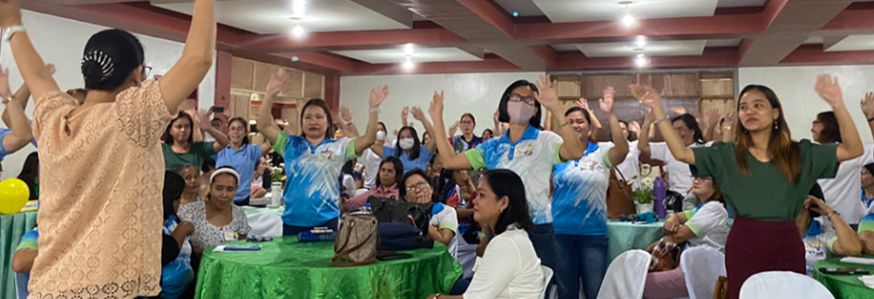
Mayors provided transport and meals to ensure teachers and parents attended the capacity-building program. The Mayor of Cabatuan utilized his discretionary fund to expand the program’s reach beyond Grade 3 teachers. Now, all the grades one and two teachers have been trained to develop reading skills. The Cabatuan Convention Center was reserved for their training needs. A copy of the Teacher’s Manual was provided to all the participants.
The Mayor of Pavia gave the teachers special treatment and sponsored their training at Robinson’s Place. And so did the Mayor of Maasin, who arranged for the training to be conducted in a hotel.
But the real treat was the mayor’s active participation. The Mayor of Igbaras recited nursery rhymes, while the Mayor of Maasin and Board Member Jason Gonzales demonstrated teaching sounds through alliteration. The Mayor of Sara wove discipline and good manners into reading instruction. Mayors from Lemery and Leganes stayed for the entire training and led the signing of the Pledge of Commitment. In Iloilo City, the Mayor invested P400,000 in the program and appointed seasoned education leader Ms. Matty Trenas to oversee the training of 220 Grade 3 teachers and principals.
Equally remarkable was the initiative of teachers and principals. Determined to surpass even the high standards set by Synergeia’s training, they planned sessions rich in creativity and relevance. They crafted innovative instructional materials and employed diverse strategies for teaching phonics and comprehension. Story reading took many forms, revealing how boundless teachers’ creativity becomes when unleashed, inspired, and appreciated.
This local effort offers valuable lessons in conducting impactful training programs. Local government units are beginning to understand that quality education is fundamental to their development agenda. They are starting to see the true value of investing in human capital—choosing to finance the development of soft skills, not just infrastructure. Their most meaningful contribution? Their time and unwavering support.
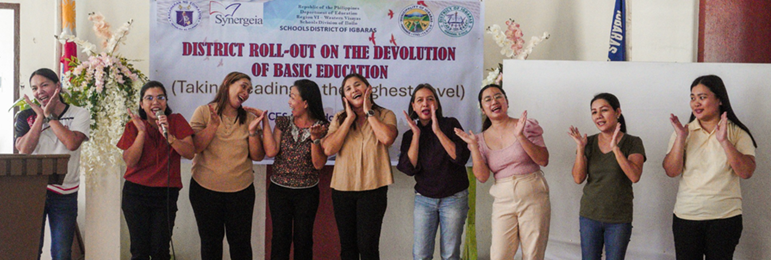
Ultimately, this training’s success highlights a powerful truth: mentoring, collaboration, peer observation, and the open exchange of experiences are some of the most effective ways to strengthen teaching capacity. More importantly, it fosters a culture of support among teachers and principals, turning them into a community and a support system.
6.9. Nanay-Tatay-Lolo-Lola-Tito-Tita Are Teachers
The parents’ workshop became a crying session. There was not a dry eye when we read Robert Munsch’s story “I Love You Forever. ” We ran out of Kleenex tissues! It was a prelude to an emotional and heartfelt sharing of experiences. Single parents, especially fathers, shared how difficult and painful it is to raise children when a spouse is absent. Parents proudly discussed how they spared no effort or time to find extra income to send their children to school.
Being a teacher at home has become second nature to the participants. We deepened their understanding of their role as a Nanay-Tatay-Guardian-Teacher by discussing how to practice positive discipline, regulating gadget time, and the importance of a shared consensus on standards of behavior at home and with the community. We held group workshops on how parents can strengthen their children’s love of reading by supporting school programs and spending some time reading with them.
6.10.How are You Doing? We spent some time visiting schools and were truly delighted with the progress that the teachers and children were making. Grade 3 children can say the sounds well and blend them to form words. More work needs to be done in developing comprehension and critical thinking, “malikhaing pag-iisip.” We saw that children are able to think, reason out, infer, and analyze if they use Filipino and, better still, Ilonggo. The children need to develop greater confidence, as they felt too shy to answer questions.
The teachers’ enthusiasm was infectious. They feel valued by their local governments. They acted out how they develop phonics and comprehension skills. We enjoyed true fellowship as we partook of simple meals from the produce of their school gardens.
We attended Local School Board Meetings and were impressed by the participation of representatives from diverse sectors. We met parents who brought their toddlers to the workshops and were again inspired by how they “labor” to earn a decent wage to send their children to school. Their wish was simple—to have more books to read to their children.
We were not prepared for what we saw in Dagami, one of the schools where children received very low comprehension scores. They were thin and tiny.
We were prepared to give parenting lessons to their parents, but they began to cry. Their children cried with them, too. And we did as well. They related that it takes the children two hours to go to school and another two hours to return, trekking rough roads. They are also hungry and tired, and they literally fall asleep on their mothers’ arms on the way home. Learning difficulties have many faces—in Dagami’s instance, hunger, distance to school, and lack of access to basic utilities such as water.
6.11.The Results of the POC. Despite all our shortcomings, the POC yielded positive outcomes. We measured students’ progress using a 50-item test that assessed their competencies in recognizing sounds, blending sounds to form syllables and words, comprehension, and thinking skills. The PIDS was consulted in drawing up the sampling frame.
The POC children did very well. One-half of the children got 9 out of 10 questions correctly. Their average score was 88%. The difference in mean scores between the control and experimental groups was statistically significant at the 1% level.
Table 2. Mean and Median Scores of Grade 3 Students from the Experimental and Control Groups, Iloilo Province and City, 2024-2025, in percent
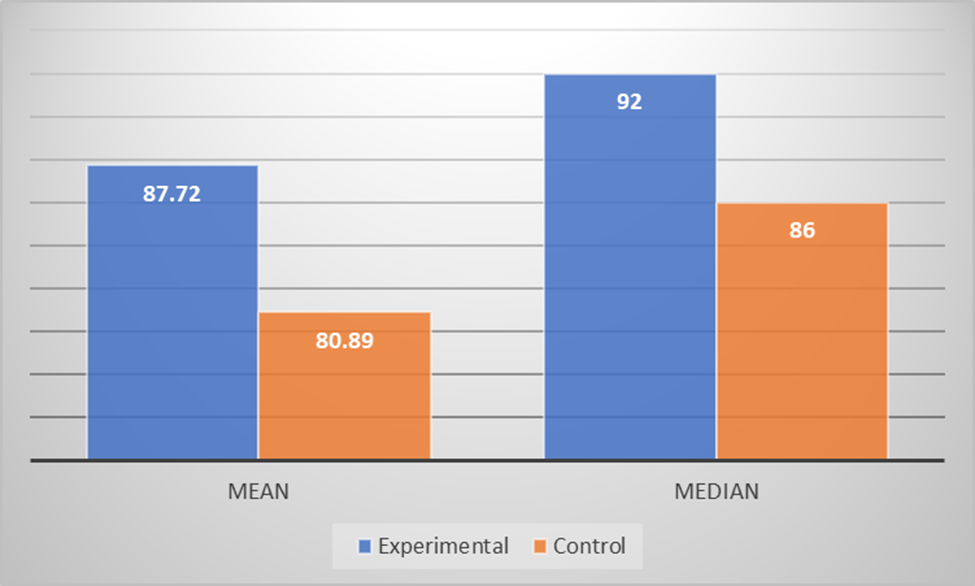
Table 3. Distribution of Experimental and Control Groups on their Test Scores, in percent
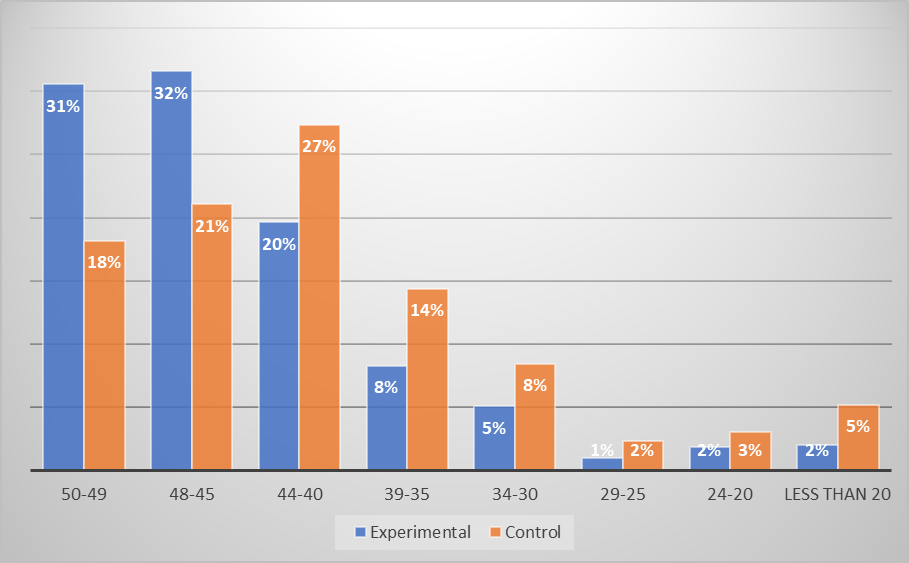
Nearly one-third of the Experimental group answered 49 to 50 items correctly!
But there are still a number of students who answered fewer than 20 test items correctly.
Table 4. Distribution of Test Scores by Reading Skills of the Experimental and Control Groups
| Filipino | Experimental | Control |
| Sound Recognition | 96 | 94 |
| Blending sounds | 85 | 79 |
| Comprehension- | 88 | 83 |
| English | ||
| Sound Recognition | 92 | 87 |
| Comprehension-understanding sentences | 74 | 51 |
| Understanding a story | 85 | 77 |
The test scores show that students do better in reading in Filipino than in English. Blending sounds is difficult, especially for the control group.
The experimental group performed better than their counterpart in reading English across the three competencies: sound recognition, comprehension, and story reading.
7. Conclusions and Recommendations
An independent observer of the POC said it well,” Synergeia did not invent a new reading system. Synergeia showed how education should be delivered. “
1. Local governments should be” co-drivers “of basic education with the Department of Education.[2] Although education is not devolved to local governments, they should consider children as their most important constituents. The children are our future.
2. The quality of governance of local governments can be measured by the learning performance of children. In the same manner, the performance of DepEd should be evaluated based on students’ learning performance.
3. Both the DepEd and local governments should be held accountable for the learning outcomes since both of them are entrusted with spending the taxpayers’ money.
4. The devolution process does not only entail changes in policies but also changes in mindset and behavior: Openness to equal partnerships, willingness to listen, use of data in planning and evaluation, and trust that all parties mean well and can contribute something to the process.
5. The delivery of capacity-building programs needs transformation using participatory needs assessment, joint efforts in planning and development of content and strategies. There should be greater use of experiential learning, interactive discussions, demonstration teaching, peer mentoring, group workshops, role-playing, and the integration of music and the arts.
6. Teachers and principals need to manage summative assessments well to track the needs and progress of students.
7. Parallel changes are needed in local bureaucracy processes in procurement, financing, and teamwork
The POC experience proved that these changes can be made. Local governments can co-manage education with the Department of Education (DepEd). Teachers and principals can perform very well if their creativity and talents are given space. Parents love their children, but they should be supported; many of them are poor, come from broken families, and are struggling to become responsible parents in a world that has greatly changed.
The way forward was also summarized, how the POC can be scaled up: “We should avoid reduction ad absurdum” (reduction to simplicity). While it takes a village to educate a child, we need to understand why the members of the village do not work together.
The scaling up of the POC hinges on the willingness and efforts of the learning community to work together. It is a difficult process, but the POC proved how it can be done.
[2] It was the former Mayor of Valenzuela, Rex Gatchalian who coined this phrase.
[1] Edwin Nacionales, Program Officer, Annie de Leon, Operations Officer, Anjanette Juan, Sr. Program Officer, Minie Manalese, Fiinance Officers. The mentors were Former Governors Josefina dela Cruz and Rafael Coscolluela; Former Mayors Alfonso Gamboa and Carlo Medina; Former Vice Mayor Jay Jalandoni. Mr. John Silva and Mr. Oscar Atendido served as mentors. The Synergeia staff members who took part in the program are Florendo Guevara, Ramon Aldana, Jessica Geronimo, Mitch Sanchez, Asleeh Casabuena and Basilio Concepcion.

